Forgepoint Forward Q3 2025: What’s Ahead in AI at the Edge
Preisha Agarwal, Rey Kirton
October 28, 2025
- Blog Post
Forgepoint Capital is excited to announce the fourth and final edition of Forgepoint Forward for Q3 2025: What’s ahead in AI at the Edge.
About Forgepoint Forward
Forgepoint Forward is a quarterly series that aims to uncover emerging opportunities for innovation and investment while spotlighting the startup landscape. Created for entrepreneurs, information security leaders, and the broader information technology community, each report combines extensive primary and secondary market research along with expert opinions and insights from our community of CISOs, CEOs, executives, and advisory council members.
Key Insights
The fourth and final edition of the series explores the state of the emerging AI at the Edge market. Here are three of the key trends and challenges we identified through our analysis:
- A key distinction: Near edge vs. far edge computing
Edge technology exists on a spectrum defined by how close it is to the endpoint device and the end user.
“Near edge” infrastructure refers to cases in which enterprises integrate edge capabilities with traditional cloud computing. For example, this might include lightweight distributions designed for the edge that enable hybrid setups, wherein heavy AI model training happens in centralized cloud clusters but inference (real-time prediction) happens at edge nodes managed under the same Kubernetes fabric. At the near edge, Kubernetes clusters may be deployed to achieve lower latency and cut soaring cloud computing costs. Kafka, MQTT, and NATS are popular data streaming and messaging systems often utilized in near edge use cases.
“Far edge” refers to cases in which computing is pushed further out to edge devices, often with limited or intermittent connectivity. When AI is deployed at this level, it typically takes the form of tiny, localized AI models making real-time decisions with ultra-low latency (milliseconds) and ultra-low power demands. At the far edge, devices like IoT sensors and connected vehicles use AI to automate decision making and real-time information delivery to end users.
- AI model inference is growing at the edge, while most model training remains cloud-based
Edge inference is emerging as a dominant AI use case. Trained AI models are increasingly being deployed on-device to process information, automate decisions, and adapt to local context at lower latency without needing to send data back to the cloud. This results in faster response times, autonomy from network connectivity, and cost savings on cloud egress. AI model training, however, still happens primarily in centralized cloud data centers due to immense computational requirements.
“We’re starting to see, for instance, Edge AI start doing machine speed detection of anomalous events, rather than sending it back to Splunk. The edge asset can take care of pre-processing and send back only high-fidelity alerts, to avoid hefty data storage and processing costs. There is a big space there, if those tasks can be done successfully and cheaply at the edge.”

Spencer Wilcox Executive Director of Cybersecurity, NextEra Energy
This is a logical trend: inferencing requires lower computational power than training but demands high accuracy and ultra-low latency, making edge deployments ideal. Devices with inference capabilities can augment prompts or route requests to different models in real time- an essential capability for use cases like autonomous driving, predictive maintenance, and real-time analytics.
Edge training, where autonomous systems store data, autotune, and update models locally, is slowly gaining some traction. However, it is significantly limited by infrastructure requirements and high computing costs. We expect most enterprises to continue training models in the cloud while shifting inference to the edge.
“There are two problems at the edge with respect to AI: training on the edge and inference at the edge, the latter is more interesting. We expect customers’ inference layers to explode in growth, but many prompt augmentation approaches are naïve. Solutions must be able to scale at the same pace.”
Derek Collison Founder and CEO, Synadia
- Enterprises face edge and AI processing, hardware, and software challenges
Enterprises face a tradeoff between greater processing power (cloud) and reduced latency (edge) when deciding whether to shift cloud applications to the edge.
Edge devices like sensors, smartphones, and IoT devices have much less processing power than data centers. They are often battery-powered and operate in environments with intermittent connectivity, so they must be optimized for low energy consumption. CXOs must evaluate the application of AI for their specific use cases to determine whether lower latency, real-time decision making at the edge is the priority, or if the development of more advanced AI models and data storage and processing power in the cloud is more important to their business and users.
Edge devices may also have difficulty handling sophisticated AI models due to hardware diversity and software fragmentation. Large, computationally intensive deep learning models deployed at the edge must be carefully pruned and optimized to be lightweight enough to run on edge hardware without compromising accuracy. In addition, edge devices capable of running AI workloads require more powerful and expensive chips, which can be a barrier in cost-sensitive industries.
Edge AI must also be uniformly deployed across a wide range of devices, each with different CPUs, Graphics Processing Units (GPUs), Tensor Processing Units (TPUs), and memory configurations. Edge platform software may also be unstandardized, with different OSs and frameworks.
AI at the edge: Market landscape
The edge AI market is still emerging, with startups addressing both edge computing and AI deployment challenges across the stack- including model optimization, orchestration, and security:
Here are the growing edge AI market segments we are particularly interested in:
- AI edge security startups protect AI models and data on distributed and vulnerable endpoint devices, helping secure model updates, implement access controls, and conduct anomaly detection.
- Data messaging systems determine how data is transferred between edge devices and include open-source protocols like MQTT, Kafka, and NATS which enable lightweight, fast communication built for the edge.
- Database management solutions offer edge-native global databases that replicate, distribute, and synchronize data, enable peer-to-peer synchronization between devices, or adapt existing databases for use at the edge.
- Model platforms unlock efficient inferencing by utilizing model quantization and pruning, making models lighter for focused tasks at the edge. Some startups in this market segment take a full stack approach, enabling enterprises to build and deploy their own Small Language Models (SLMs).
- Orchestration providers manage clusters and AI workload deployment, scaling, and coordination across devices, and often include inbuilt security measures such as authentication.
What enterprises want from next-generation edge AI technologies
While AI has clear value at the edge, the market is still in the early stages of innovation. Many organizations grapple with integration complexity, fragmented hardware environments, security concerns, and limited internal expertise. Successfully integrating AI at the edge will require further innovations in computing efficiency, model compression, orchestration, security, and data lifecycle management across highly distributed and intermittently connected environments.
Here’s what the security and AI experts we spoke to want to see from edge AI startups and solutions:
- Lower latency
Most if not all applications can be improved with more speed. A core driver for edge technology is a need for ultra-low latency. Lower response times (sub-100ms at the near edge and as low as sub-5ms at the far edge) are essential for complex real-time control systems (self-driving cars) and real-time handling and user (re)display of device inputs (speech to text, camera filters/image correction). In certain specialized cases like industrial robotics, jitter- the consistency of latency- is also critical because predictable and consistent response times are needed to ensure safe and accurate machine actions. Jitter tends to be lower at the far edge than the near edge.
“At the edge, latency is a primary factor. It depends on the target industry, the data they want and how often. Some companies want their data very quickly, others want it in their Azure or Databricks before moving it into a data warehouse solution. The closer you get to the operation, the more latency becomes a factor.”

Miles Hill Co-founder and former CEO, Rivitt
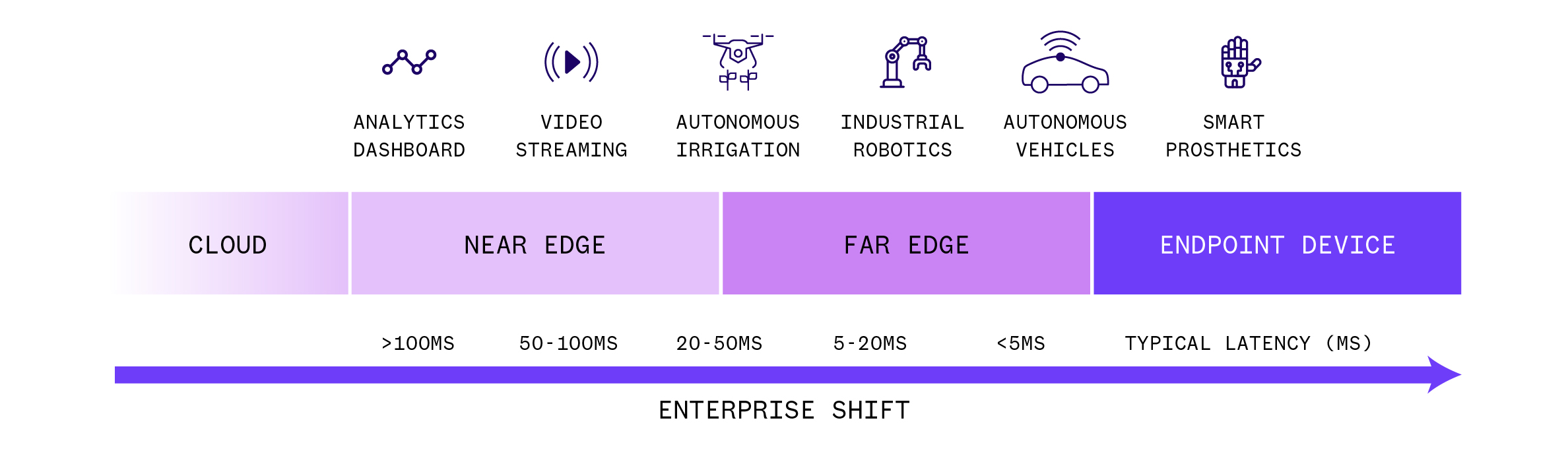
Applications with near-instantaneous data processing benefit most from the low latency associated with processing at the edge. As more computational power and storage capabilities are placed where the data is being generated or consumed, decision making can happen in near real time.
However, enterprises leaders navigate a precarious balance between performance gains and the increased cost and complexity associated with building edge infrastructure. As applications built at the edge diversify and multiply, they become more complex and require even lower latency and more flexibility, interoperability, and inbuilt security. To meet these heightened requirements, enterprises with distributed architectures are beginning to move to the far edge rather than simply collecting and preprocessing data at the near edge.
- Edge security
Unlike in the cloud, AI-based applications in edge environments are not protected by traditional security technologies and standard privacy protection mechanisms. Security solutions like EDR are too heavyweight to operate in edge environments, requiring continuous connectivity which is not always feasible at the edge. Securing AI applications at the edge requires a different approach- starting with the unique risk profile at the edge.
Edge environments are highly distributed and support a large number of users. This introduces risks like intellectual property theft and model poisoning which targets continual learning- poisoning the local model before it is aggregated to the centralized server- to reduce the accuracy of the global model and create widespread hallucinations and false outputs.
Given these risks, user access policies are an important consideration. Executives are seeking advanced authentication and authorization systems to protect their applications at the edge. Concerns regarding data confidentiality also affect how companies build edge environments and select solutions. High-risk AI applications, particularly in industries with strict privacy requirements such as finance, healthcare, and government, may push executives to look for solutions with embedded data governance, security, and user privacy capabilities.
-
“That's been my biggest problem with IoT and Edge. The assets are harder to manage, getting firmware updates and maintaining security against attackers across these devices can get very difficult, because they're placed in remote locations. There are network protections on the assets, but when AI comes into play, it grows into a larger concern.”
Spencer Wilcox Executive Director of Cybersecurity, NextEra Energy -
“The more power given to the edge, there is a tradeoff between innovation and security. We must look for ways to power next generation use cases while still being secure, but we’re still in the Wild West. To deploy, enterprises must define clearly security and service policies and ensure the exposure is worth the risk.”

Tim Booher SVP, Leidos; former VP of Autonomy, Boeing -
“There's a huge appetite to procure [edge capabilities] and to put artificial intelligence capabilities into it. The integrity of that asset is critical since the data that it's presenting back is what I operate on. Key considerations around the adoption of these capabilities and technologies include human-in-the-loop requirements and mechanisms to be able to validate when the machine is wrong.”
Spencer Wilcox Executive Director of Cybersecurity, NextEra Energy
- Flexibility and Interoperability
Executives are looking for ways to connect a large volume of devices and monitor them at the same time. The overall efficiency of edge computing and edge AI relies upon standardized data formats and seamless communication between systems, given the diversity of edge data sources and applications.
Since the location of edge nodes is flexible, node management must be equally flexible, adapting to new requirements with efficient updates across diverse environments including remote sites, factories, and retail sites. The need to scale at the edge may push executives toward solutions that offer centralized end-to-end management and orchestration. Investing in these capabilities can shorten time to market and may help companies gain a competitive advantage.
Are we bullish or bearish on AI at the edge?
Read the full report to find out:
- What industry-leading cybersecurity leaders, technology executives, and AI experts have to say about AI at the Edge and what approaches they find most compelling
- How Edge AI startups can enable more efficient and secure edge use cases
- Our take on the market (are we bullish or bearish?) and what might change our minds
Download the report here:
Acknowledgements
Special thanks to the following experts for their insights and contributions:
- Tim Booher, SVP, Leidos; former VP of Autonomy, Boeing
- Derek Collison, Founder and CEO, Synadia
- Chris Sharp, Managing Director of Product, JPMorgan Chase
- Miles Hill, Co-founder and former CEO, Rivitt
- Spencer Wilcox, Executive Director of Cybersecurity, NextEra Energy
For Forgepoint Capital:
Preisha Agarwal, Analyst
Rey Kirton, Principal
Kathryn Shih, Venture Partner
Conor Higgins, Marketing Consultant